
Why every gram counts: weight, wet weight and what it costs you in the field
13.10.2026
Runners have a rule of thumb: every extra pound you carry costs you about two seconds per mile. For some, that means room for another Snickers. For a soldier or police officer, the extra weight is paid for in speed, endurance and focus, exactly when they matter most. This article looks at where the weight in your kit actually comes from, why the number on the spec sheet isn’t the number you carry, and how to cut it.
Weight adds up faster than you think
No single pouch feels heavy. The problem is that load carriage is made of dozens of items, and the empty weight of each one is carried all day, every day, before you add a single magazine or litre of water. Some comparisons from our own kit:
| Item | Typical | L4 | Saving |
|---|---|---|---|
| 3-day assault pack | ~2.1 kg | 1.1 kg | ~1.0 kg (48 %) |
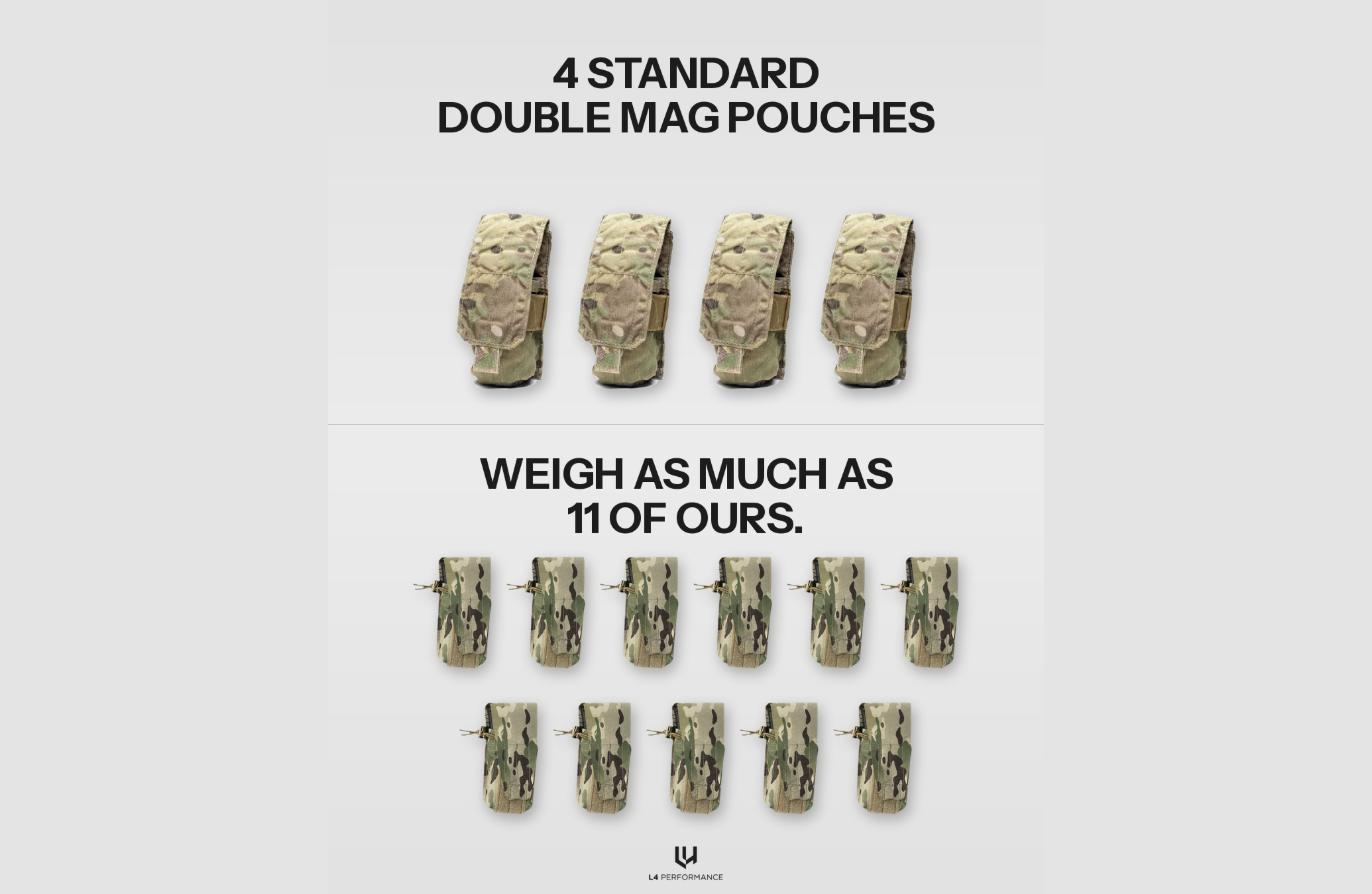
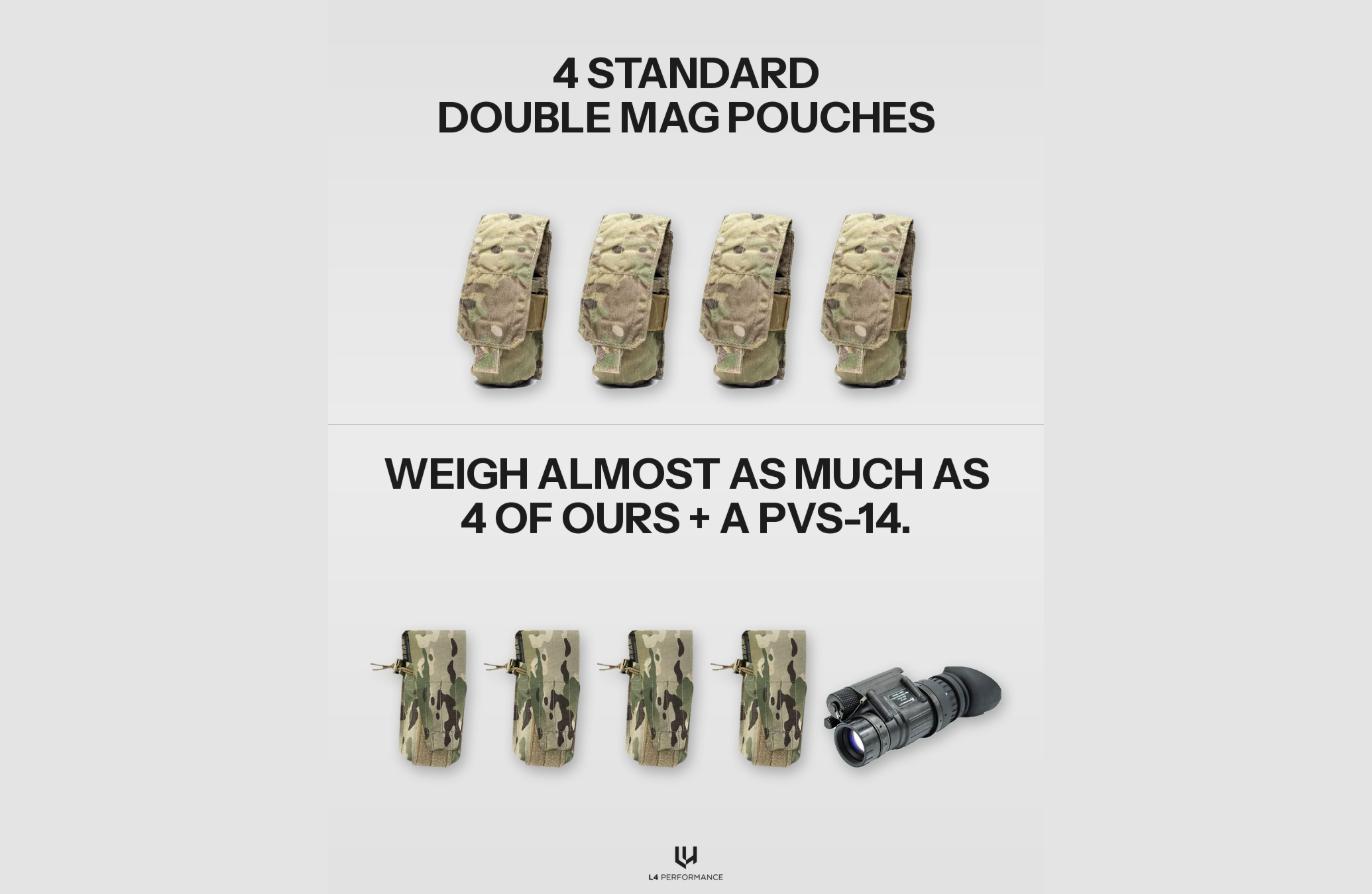
| Double magazine pouch | ~125 g | 46 g | ~79 g per pouch (63 %) |
| Chest rig (dry) | ~1.1 kg | 0.4 kg (WCSIG) | ~0.7 kg (64 %) |
Put differently: a typical 3-day pack weighs about as much as two L4 3DAPs. Four typical double mag pouches weigh about as much as eleven of ours. Swap four pouches and the weight you save is roughly the same as six Snickers bars, every day you wear the kit.
Dry weight vs wet weight
Spec sheets list dry weight. In the field, kit gets wet: rain, snow, sweat, river crossings. Fabrics absorb water at very different rates, and the weight you actually carry can be much higher than the catalogue figure. Typical water pick-up as a share of the material’s own weight:
| Material | Typical wet gain | Why |
|---|---|---|
| PU-coated, DWR-treated Cordura | 15–35 % | The woven face fabric holds water |
| Woven binding tape | 40–80 % | Water sits between the yarns |
| Laminates | 10–25 % | No open structure in the middle, only the outer faces hold water |
| X-Pac | 10–18 % | The film stops water passing through |
| Curv (polypropylene) | under 0.01 % | A solid sheet, only a thin surface film of water |
Three more things make wet weight worse:
- Worn or dirty DWR absorbs more water than a new finish.
- Seams and stitch holes wick water, so heavily sewn items gain more.
- Foam padding, mesh and spacer fabric inside a product can absorb far more than the outer shell.
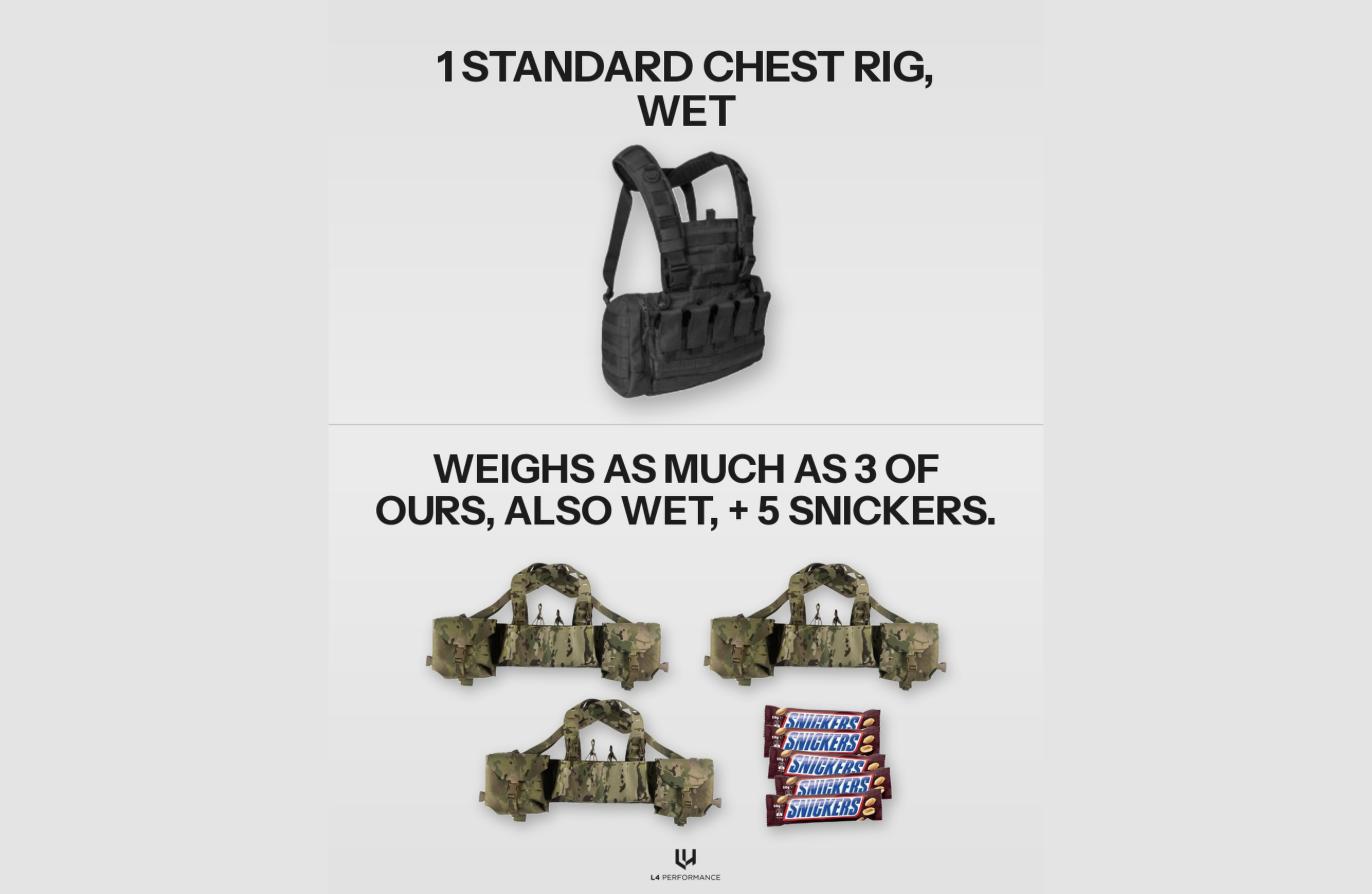
In our comparison, a conventional Cordura chest rig weighing about 1.1 kg dry weighed about 1.6 kg when soaked. The WCSIG, built from laminate with minimal binding and padding, weighs 0.4 kg dry and under 0.5 kg wet. One wet conventional rig weighs about as much as three wet WCSIGs and a handful of energy bars.
How we design for low weight
- Laminates and laser-cut construction instead of layered Cordura and sewn webbing. Fewer layers, fewer seams, less water.
- Minimal binding tape and padding. Padding goes only where it does a job, and is removable where possible.
- Curv and other non-absorbing materials for structure.
- Using space you already carry, such as storage inside plate bags, instead of adding pouches.
How to cut weight from your own loadout
- Weigh everything, empty and full. You can’t manage what you don’t measure. A kitchen or luggage scale is enough.
- Remove what you don’t use. Every pouch should hold something you use on every task.
- Replace the heaviest items first. Packs, carriers and rigs offer the biggest savings per euro.
- Check the wet weight. Soak an item, let it drip for a few minutes and weigh it again. The result is often surprising.
- Keep your DWR fresh and dry your kit properly between uses.
- Spend the savings wisely. Weight saved on kit can be spent on what matters: water, ammunition, batteries or medical kit, or simply on moving faster and further.
The bottom line
For some, ultralight kit means room for another Snickers. For others, it’s the margin between a successful mission and the last one. Ultralight means more speed, more distance and more performance.